Molecular Docking
Representation – Genome
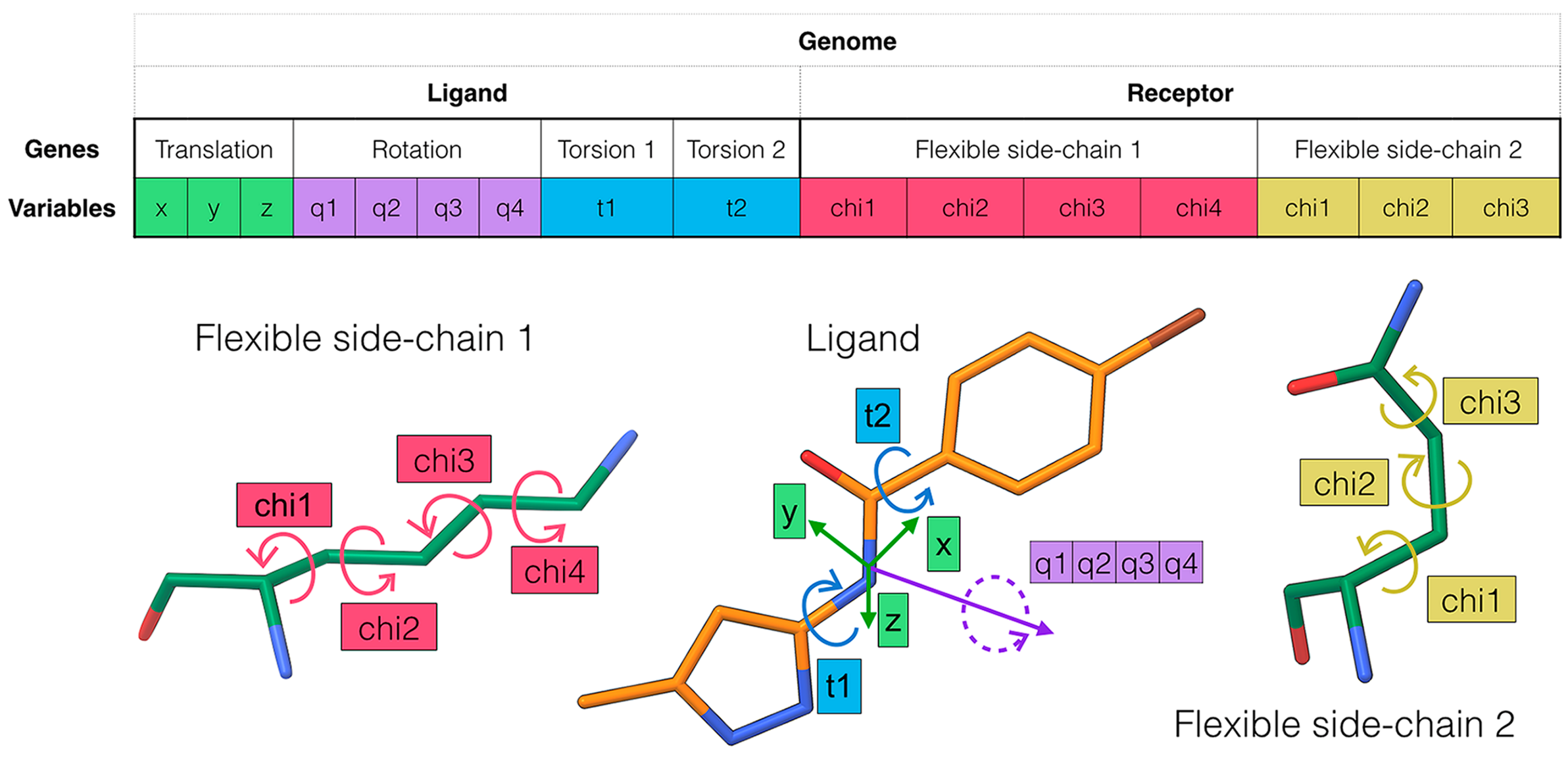
Genome used by ADFR to encode the docking of a flexible ligand into a receptor with two flexible side-chains.
https://doi.org/10.1371/journal.pcbi.1004586
Scoring function
The AutoDock energy function is a weighted sum of terms representing van der Waals, hydrogen bond, electrostatic, and desolvation contributions, which are calculated between pairs of atoms.
\[ E = w_{vdW}\sum_{i,j}\biggl(\frac{A_{i,j}}{r_{i,j}^{12}} - \frac{B_{i,j}}{r_{i,j}^6}\biggr) + w_{hbond}\sum_{i,j}E(t)\biggl(\frac{C_{i,j}}{r_{i,j}^{12}} - \frac{D_{i,j}}{r_{i,j}^{10}}\biggr) + w_{elec}\sum_{i,j}\biggl(\frac{q_iq_j}{\epsilon \space r_{i,j}.r_{i,j}}\biggr) \\ + w_{sol}\sum_{i,j}(S_iV_j + S_jV_i)e^{\bigl(\frac{-r_{ij}^2}{2\sigma^2}\bigr)} \]

The ADFR score uses this energy function to independently score the interactions between the following three groups of atoms: Ligand atoms (L), Rigid Receptor atoms (RR) and Flexible Receptor atoms (FR).
\[ S_{ADFR} = E_{L-L} + E_{L-RR} + E_{L-FR} + E_{FR-FR} + E_{FR-RR} \]
https://doi.org/10.1371/journal.pcbi.1004586
Affinity maps
Without (A) and with (B) gradient.
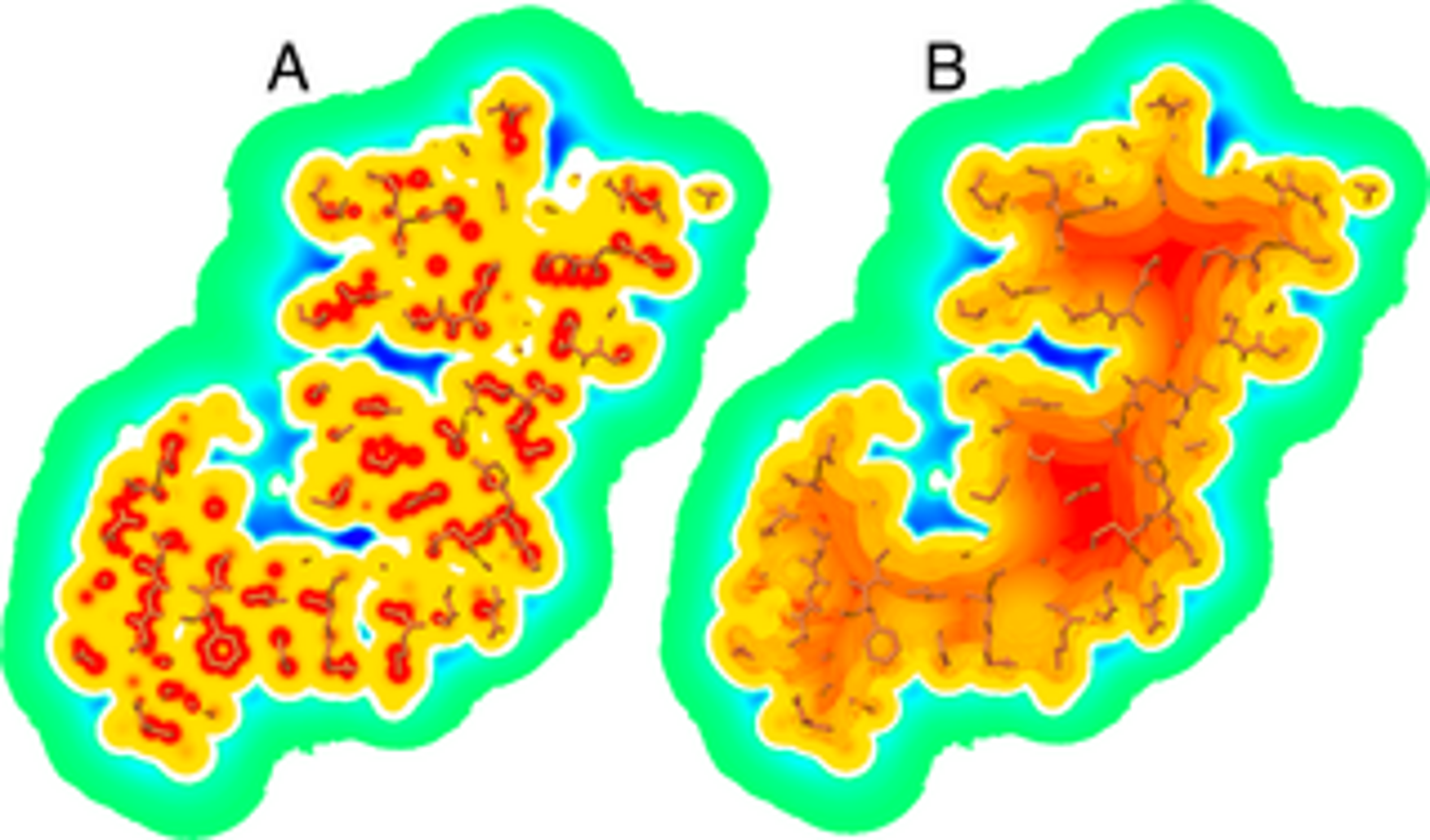
The color gradient outside the protein surface indicates favorable interactions going from weak (green) to strong (blue). Inside the protein surface the color gradient indicates unfavorable interactions going from low (yellow) to highly unfavorable (red).
This protocol produces maps that facilitate the search by providing a gradient for resolving clashes and by removing buried favorable cavities too small to accommodate a ligand e.g., trapped water cavities.
https://doi.org/10.1371/journal.pcbi.1004586
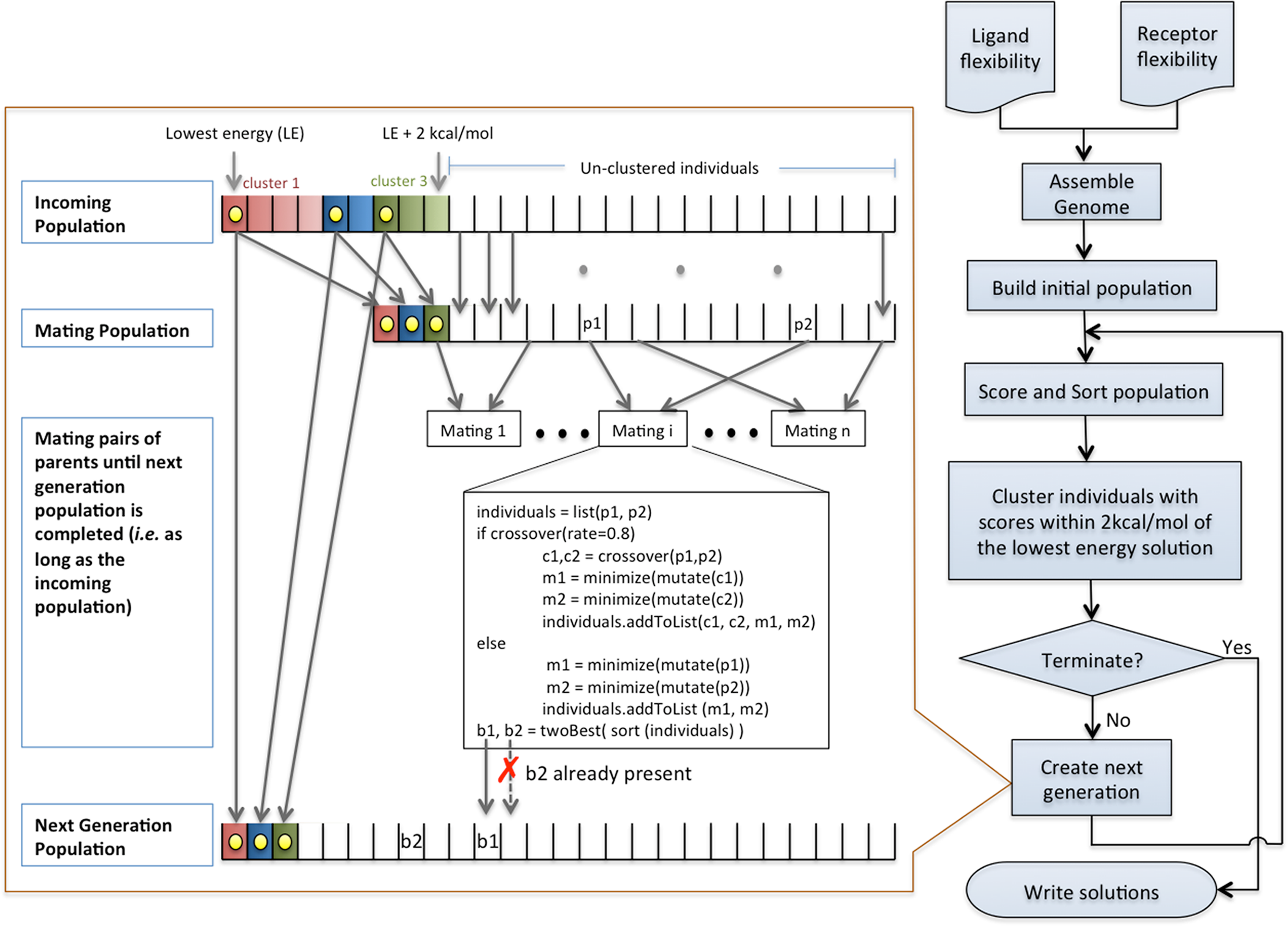
Overall flowchart of ADFR
https://doi.org/10.1371/journal.pcbi.1004586
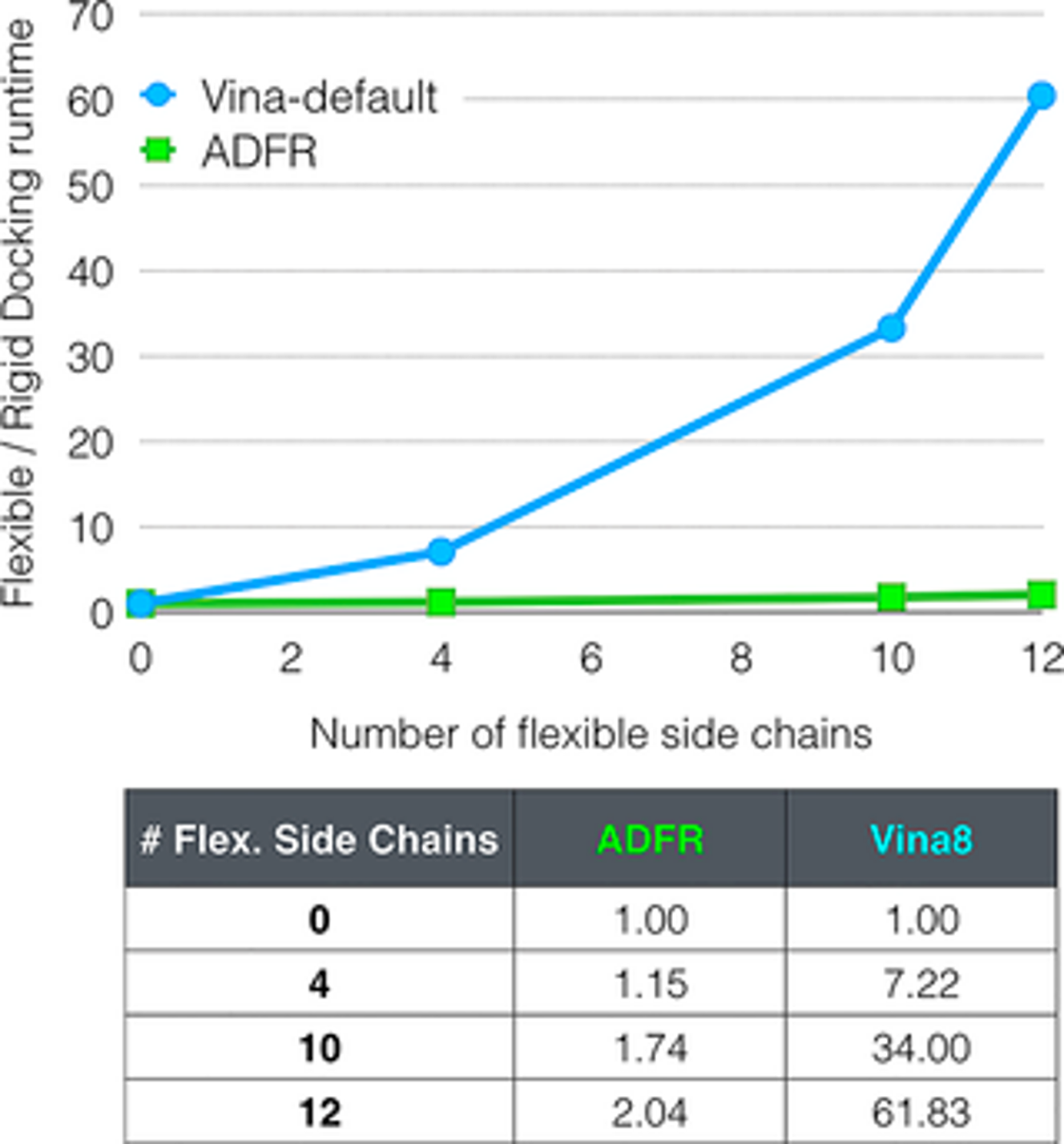
ADFR vs Vina
Scaling of docking runtimes as function of the number of flexible receptor side-chains
https://doi.org/10.1371/journal.pcbi.1004586
Thank you!

manish@bioinfo.guru